
5 Stages of a Forensic Investigation Explained: What Students Learn in Forensic Science at Rayat Bahra University
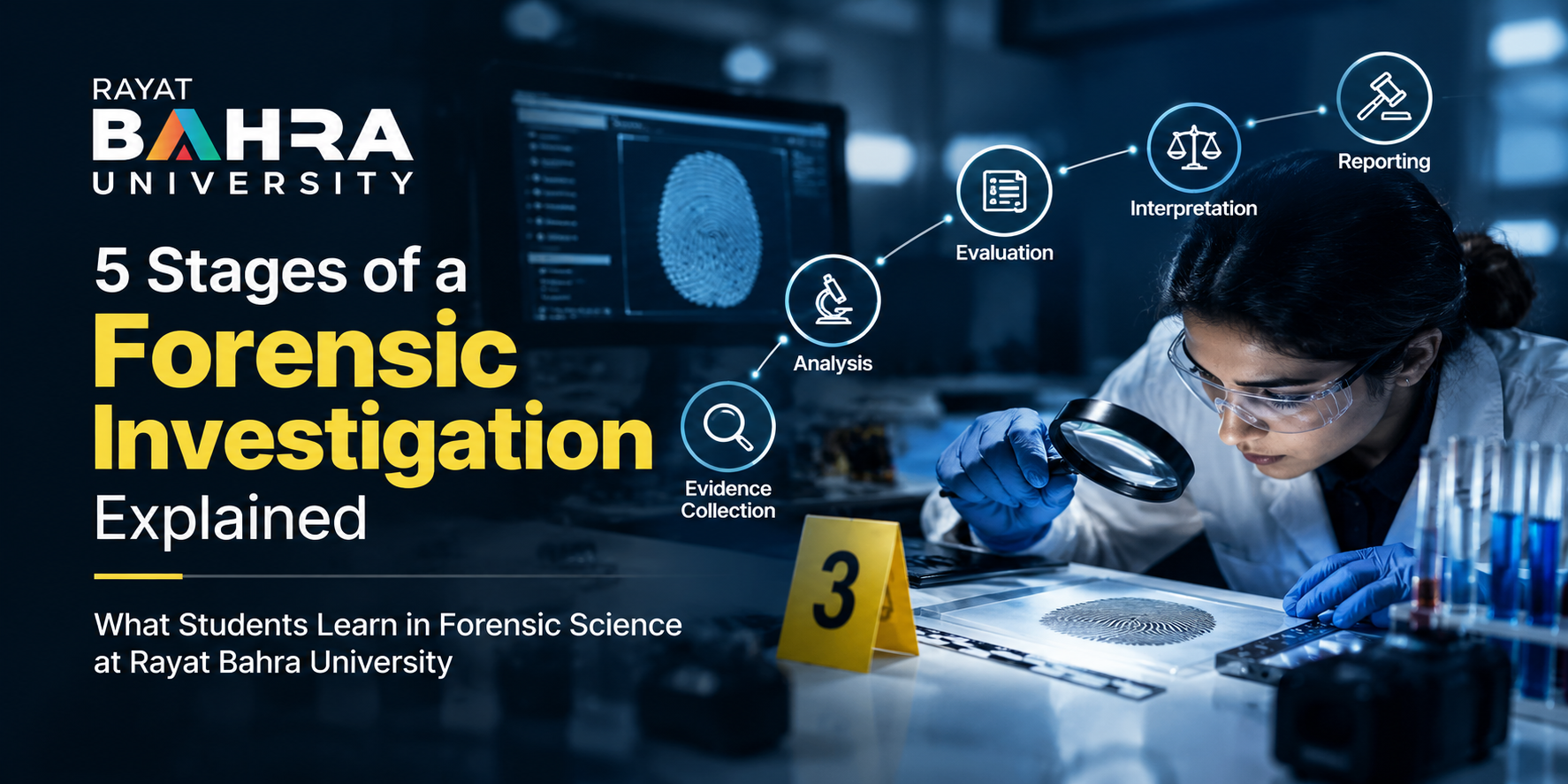
Forensic science is the use of scientific methods to answer questions that matter to the law. Who was at a scene? What substance is this? Did a person’s phone hold a particular file? Was a death caused by a drug or poison? To answer questions like these in a way a court can trust, forensic scientists follow a fixed sequence of steps.
This blog explains that sequence in five stages. For each stage, you will learn how the work is done, why it is done that way and what can go wrong. At the end of each stage, you will also see where it connects to the B.Sc and M.Sc Forensic Science programs at Rayat Bahra University in Mohali.
Table of Contents
1. Securing and Documenting the Scene
1.1 What happens
A crime scene is a one-time record. Once something is moved, stepped on or touched, it cannot be put back exactly as it was. That is why the first stage is about protection and recording, not collecting.
The National Institute of Justice (NIJ) guide for crime scene investigation breaks scene work into four parts. The first covers the initial response, which includes safety, emergency care, controlling who is at the scene and setting boundaries. The second is preliminary documentation and evaluation, where investigators assess the scene and do a “walk-through” to decide what needs to be recorded and in what order. The third is processing the scene, which covers contamination control, documentation, and then collecting, preserving, inventorying, packaging, transporting and submitting evidence. The fourth is completing the investigation, with a final survey and final documentation.
1.2 How documentation works
The scene is recorded in three ways at once.
1.2.1 Notes
Investigators write down the condition of the scene as it was found. These notes are updated throughout the investigation.
1.2.2 Photography and video
The NIJ calls still photography the primary means of documentation. The photographer must be able to testify that a photograph is a true and accurate representation of the scene at the time it was taken. That is why nothing is moved until it has been photographed.
1.2.3 Sketches
A sketch shows the layout and the relationships between objects, which photographs do not always show clearly. The NIJ guide advises drawing the rough sketch before anything is moved.
1.3 Chain of custody
Every item collected needs a record of who handled it, when and why. This record is called the chain of custody. It is defined as the process used to maintain and document the chronological history of the evidence. Without it, a court can reasonably ask whether the item presented is really the item collected, or whether it was changed along the way.
B.Sc Forensic Science at Rayat Bahra University names crime scene investigation as one of the areas the degree builds knowledge in. The M.Sc programme lists crime scene preservation and evidence collection among the practical activities students take part in.
2. Reading Pattern and Trace Evidence
2.1 Fingerprints
Most fingerprints found at a scene cannot be seen. These are called latent prints. They are formed by sweat and oily secretions that naturally sit on the skin of the fingertips, and they transfer to a surface when it is touched. Because most latent prints are colourless, they must be developed, or made visible, before they can be preserved and compared.
Once a print is visible, examiners look at two levels of detail. The first is the overall pattern. Fingerprints fall into three broad families: loops, whorls and arches. Loops are the most common, making up about 65 percent of patterns. Whorls account for about 30 percent, and arches and tented arches together make up the remaining 5 percent.
The second level is finer. It is the ridge detail, known as minutiae. These include points where a ridge ends and points where a single ridge splits into two. It is the combination of these small features, not the broad pattern, that helps tell one person’s print from another’s.
Examiners commonly follow a structured method called ACE-V, which stands for Analysis, Comparison, Evaluation and Verification. In the analysis step, the examiner studies an unknown print to judge how much usable detail it holds. Smudges, pressure and the method used to develop the print all affect that judgement. The verification step means a second examiner checks the conclusion.
2.2 Fibres and impressions
Not all trace evidence is a fingerprint. Fibres can move between clothing, carpets and furniture when two surfaces come into contact. Impressions, such as teeth prints and lip prints, can be left on skin, food or objects. Each type of evidence needs its own handling, since a fibre can be lost with one careless movement while an impression can be distorted by pressure.
The common lesson is that not every comparison is equally reliable. This is why validated methods, careful records and verification by a second person matter in this stage.
The B.Sc Forensic Science at Rayat Bahra University lists fingerprint analysis among its areas of knowledge. The M.Sc page lists fingerprinting, fibre analysis, teeth prints, lip prints and evidence collection among the practical activities offered to students.
3. Laboratory Analysis of Chemistry, Toxicology and DNA
Evidence that cannot be settled by eye goes to the laboratory. Three areas are especially common.
3.1 Forensic chemistry
Forensic chemistry identifies unknown substances. A white powder, a liquid in an unlabelled bottle or residue left on a surface cannot be named by looking at it. Chemists use tests to work out what a material is made of. The B.Sc page names forensic chemistry as one of its areas of knowledge.
3.2 Forensic toxicology
Toxicology is the analysis of biological samples to detect toxins, including drugs and poisons, in support of the judicial process. Samples can include blood, urine, vitreous humour (the fluid in the eye), liver and brain tissue.
A key idea in toxicology is that testing happens in two steps. The first is a screening test. It is quick and broad, but its result is only presumptive, meaning it suggests a substance may be present. It cannot be reported as a final identification. The second step is a confirmation test using more specific methods, most commonly gas chromatography-mass spectrometry (GC-MS) or liquid chromatography-tandem mass spectrometry (LC-MS/MS). These methods separate the compounds in a sample and identify them by their chemical structure. This two-step approach reduces the risk of reporting a false result.
3.3 DNA profiling
DNA is the most widely known form of forensic evidence, but the way it is used is often misunderstood. Labs do not read a person’s entire genetic code. The standard method, called short tandem repeat (STR) analysis, looks at specific regions of DNA in which a short sequence repeats a variable number of times. The number of repeats differs between individuals.
In practice, the lab copies these target regions using a process called PCR. It then separates and detects the copies, counts the repeats at each region and records the result as a DNA profile. That profile is compared with another sample. The more regions that are compared, the smaller the chance that two unrelated people would share the same profile. The NIJ notes that, for a good-quality sample with data at all 13 core regions used in the United States, the typical chance of an unrelated person matching is around 1 in 1 billion.
The B.Sc Forensic Science programme at Rayat Bahra University names forensic chemistry, toxicology and DNA profiling among the areas the degree builds knowledge in.
4. Recovering Evidence from Digital Devices
4.1 Why it is a forensic field
Phones, laptops, memory cards and networks hold messages, files, location data and records of activity. Digital forensics is defined by the US National Institute of Standards and Technology (NIST) as the application of science to the identification, collection, examination and analysis of data while preserving the integrity of the information and maintaining a strict chain of custody.
4.2 The four phases
NIST describes the process in four phases.
- Collection. Data relevant to the event is identified, labelled, recorded and acquired.
- Examination. The data is processed using automated and manual methods to bring out the relevant material.
- Analysis. Conclusions are drawn using methods that are legally justifiable.
- Reporting. The results are described, along with the actions taken.
4.3 Keeping the evidence unchanged
The biggest risk in digital work is changing the evidence while looking at it. Simply opening a file can alter details such as access times. To prevent this, examiners use a write-blocker, a hardware or software tool that stops data from being written to the original device. They then work from a copy.
To prove the copy is exact, examiners use a hash value, a short fixed-length value computed from the data. If even one small part of the data changes, the hash changes. Comparing the hash of the original with the hash of the copy shows whether the two match. This is how digital evidence stays trustworthy.
The B.Sc Forensic Science at Rayat Bahra University lists digital forensics among its areas of knowledge.
5. Reporting What the Evidence Shows
5.1 Why the last stage matters most
All of the earlier work depends on one thing: that someone else can understand it, check it and rely on it. A finding that cannot be explained clearly or defended under questioning has little value, however good the lab work was.
A sound forensic report states what was received, what was done, what was found and what the limits of the findings are. It does not claim more than the evidence supports. In the digital process, NIST also lists reporting as a distinct phase, which covers describing the actions taken.
5.2 Thinking objectively
A forensic scientist does not decide who is guilty. That is the work of a court. The scientist’s role is to report what the evidence shows. This calls for a particular habit of mind. The M.Sc page says the course trains students to use facts, logic and objective thinking, not emotions, feelings or subjective assumptions, when solving crimes and problems.
The M.Sc in Forensic Science at Rayat Bahra University exposes students to research, present their research studies, examine famous crimes and write research papers to show their understanding of a crime and the processes used to solve it. The program also uses note taking and reading, as well as educational and commercial films related to forensic science.
6. How the B.Sc and M.Sc Fit Together
The B.Sc Forensic Science at Rayat Bahra University is a four-year professional science degree. The program page says students study forensic science along with basic science subjects and some allied health science subjects. The idea is to widen what a graduate understands about solving crimes. The degree is listed under the university’s Allied Health Sciences programs.
The M.Sc Forensic Science is a two-year postgraduate program. The page describes it as a course meant to broaden understanding of forensic science and crime scene investigation, while building observation, organisation and thinking skills. Its practical activities include fingerprinting, fibre analysis, crime scene preservation, teeth prints, lip prints and evidence collection.
Placed side by side, the five stages above show how the two programs relate. The B.Sc builds the scientific base across chemistry, toxicology, DNA, fingerprints and digital evidence. The M.Sc puts more weight on practical work, research and writing.
7. The Main Idea to Take Away
A forensic case is a chain, and each stage depends on the one before it. A scene that was not documented cannot be rebuilt. A sample handled without a chain of custody can be challenged. A lab result without confirmation can be wrong. A report that overstates the evidence can be misleading. Learning forensic science means learning how to keep every link in that chain strong.
To see the full details of each program, visit the official pages:
- B.Sc Forensic Science: https://rbuchd.in/programs/bsc-in-forensic-science/
- M.Sc Forensic Science: https://rbuchd.in/programs/msc-forensic-science/